 Deutsch
 Français
TOPCon vs Back Contact: A Fake Duel ?
Intersolar 2025 marked a turning point for TOPCon technology. Many manufacturers introduced “optimized” versions of their modules, delivering up to +20 W in additional power output. These gains are the result of various technical improvements, some already deployed, others expected by the end of 2025.
But this boost in performance may only be a temporary response before Back Contact takes the lead.
Optimizations in “Next Gen” TOPCon
The latest TOPCon modules benefit from several key improvements :
Visible busbars are eliminated. Instead, electrical connections are made using ultra-thin copper wires embedded in a polymer film directly laminated onto the cells.
- Less shading → more light captured
- Lower thermal stress → reduced risk of microcracks and hotspots
- Compatible with thinner cells (reduced material usage
➤ Estimated gain: +5 to 8 W per module
Laser cutting of half-cells degrades the passivation layer at the edges, lowering efficiency. A secondary passivation step restores electrical performance.
Reduced current losses from exposed edges
➤ Estimated gain: +3 to 5 W
The n+ doped layer is concentrated only around the rear contact fingers, instead of being applied across the entire surface.
- Fewer recombinations → better electrical performance
Increased bifaciality rate
➤ Estimated gain: +2 W and +5% bifaciality
The front glass uses two stacked anti-reflective coatings (ARC) instead of one, improving light transmittance.
- More efficient light capture
➤ +2.5% gain in transmittance
➤ Power gain: significant but not precisely quantified
A thin optical film is used to redirect incident light from inactive zones (between cells) toward active cell areas.
- More effective use of incoming light
➤ Estimated gain: +3 to 5 W
Key Considerations
Manufacturers will not necessarily implement 100% of these improvements at once, which will lead to performance disparities across products in the same range (e.g. 1762 x 1134 TOPCon vs 2382 x 1134 TOPCon).
Most manufacturers won’t change product references; instead, they update existing IEC certifications. “High power” versions will have limited availability in Q3 and Q4 2025, resulting in two modules with the same name but different power roadmaps.
These high-performance versions are likely to come with a price adder, due to limited capacity and more expensive materials.
- With this jump in nominal power, many certifications based on power output will require updates (e.g. IEC, ETN/ATEx/ATEC, ECS).
TOPCon vs Back Contact: What Can We Expect ?
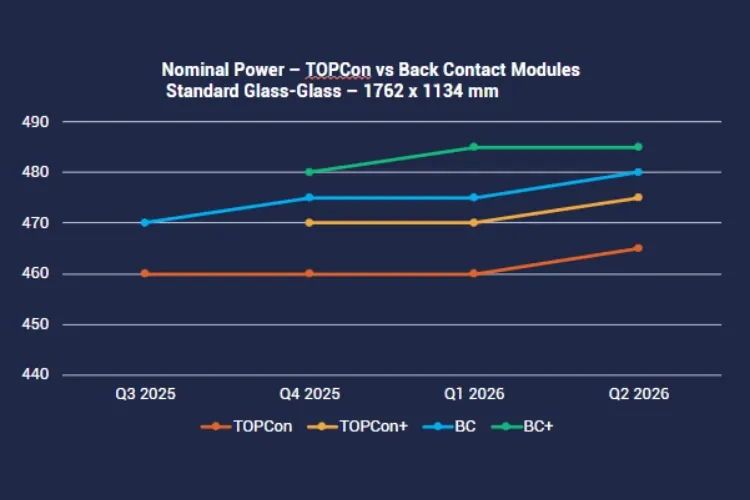
With all these enhancements, TOPCon's power roadmap is beginning to overlap with Back Contact at equivalent dimensions... but perhaps only briefly.
TOPCon is nearing its theoretical efficiency ceiling (~28.7%) and is expected to plateau around 27% even with full optimizations.
Back Contact, on the other hand, still has significant room for improvement.
Synapsun’s Perspective :
We’re likely to see both technologies coexisting until 2026, before a probable shift in favor of Back Contact.
For design offices, installers, and PV buyers, this means:
- Going beyond product references and analyzing datasheets carefully
- Closely tracking manufacturer roadmaps
- Anticipating performance variations within the same module reference
Sources :
- Taiyangnews (05/2025) Next-Gen Solar Cell Technologies & Projections, available on https://taiyangnews.info/technology/next-gen-solar-cell-technologies-projections
- PV Magazine (06/2025), JinkoSolar Unveils White Paper on TOPCon and Tiger Neo 3.0, Signaling Next-Gen Solar Technology Shift, available on https://www.pv-magazine.com/press-releases/jinkosolar-unveils-white-paper-on-topcon-and-tiger-neo-3-0-signaling-next-gen-solar-technology-shift/
- PV Tech (01/2025), JA Solar unveils DeepBlue 5.0 series of n-type solar modules, available on https://www.pv-tech.org/ja-solar-unveils-deepblue-5-0-series-n-type-solar-modules/
- Taiyangnews (12/2024), Day 3: TaiyangNews High Efficiency Solar Technologies 2024 Conference, available on https://taiyangnews.info/technology/day-3-taiyangnews-high-efficiency-solar-technologies-2024-conference